PitchKitchen Frameworks
What Is AI-Parmesan?
The fundamental premise
Look at the hero headline on most B2B homepages today.
You'll see something like:
- “The AI-powered platform that empowers your team.”
- “Agentic workflows for the modern enterprise.”
- “Intelligent automation. Real results.”
- “Next-gen AI for B2B revenue teams.”
Cover the logo. Could be anyone. SaaS, services, healthcare, fintech. The headline doesn't change. The buyer doesn't recognize anything specific to their world. The vendor sounds confident and says nothing.
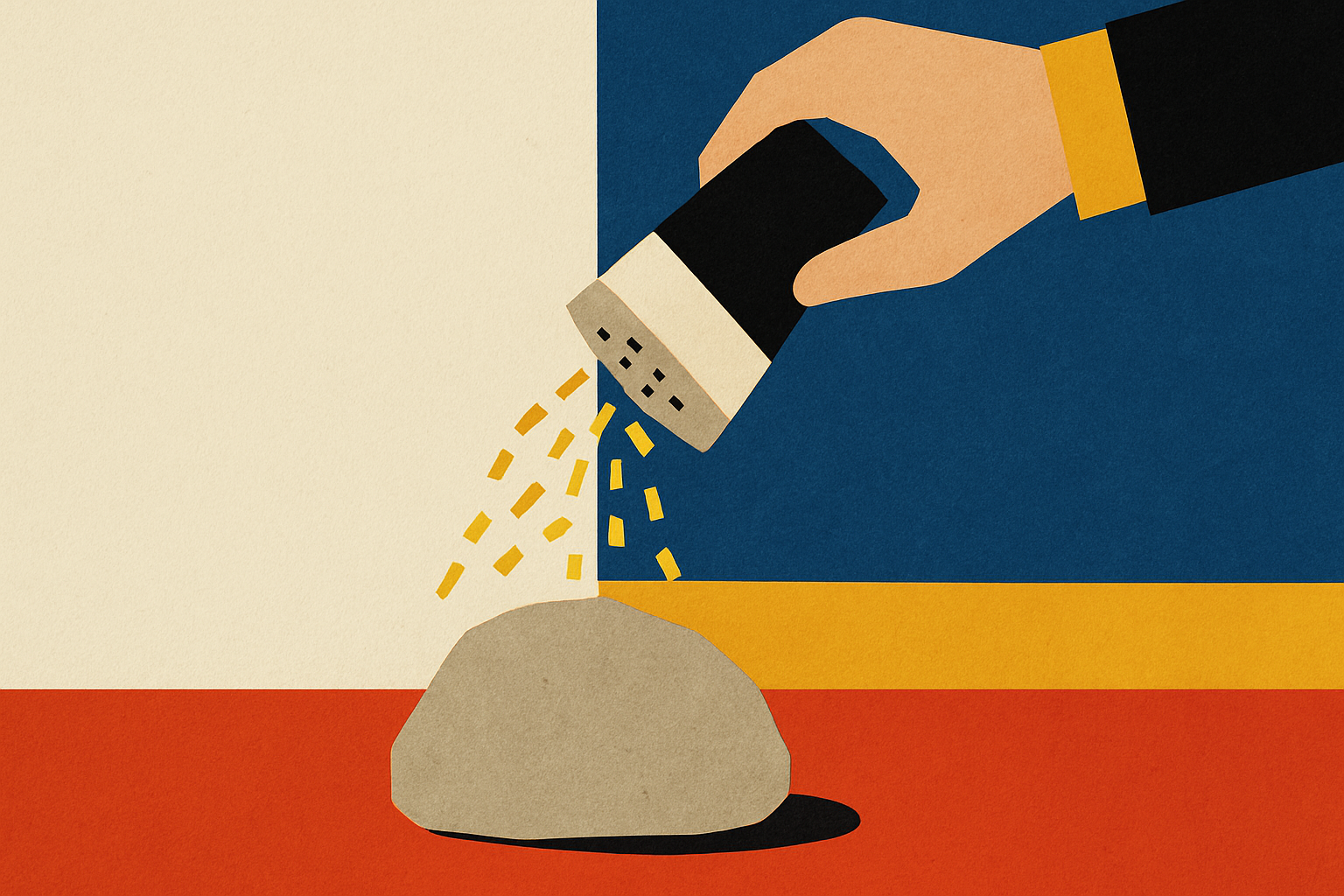
That's AI-Parmesan. Buzzwords grated on top of a narrative that was already generic, in the hope that “AI” will do the differentiation work the messaging refused to do.
It never does. The cheese isn't the problem. The dish is the problem. And AI is making the dish worse, not better.
Definition
AI-Parmesan is an anti-pattern, coined by Greg Rosner, founder of PitchKitchen, describing the act of sprinkling "AI-powered," "intelligent," "agentic," or "next-gen" onto a weak underlying B2B narrative. Like grating parmesan on a bad dish to mask the flavor, AI buzzwords don't fix broken messaging. They multiply it. The fix isn't a better tool. The fix is a real brand bible.
Coined by Greg Rosner. Documented in PitchKitchen's Magnetic Messaging Framework. Used by B2B founders, CROs, and fractional CMOs to diagnose the most common homepage failure of the AI era.
Why the term exists
Greg Rosner coined AI-Parmesan after auditing more than 200 B2B homepages in 2024 and 2025 and watching the same pattern repeat. Every founder reached for “AI-powered.” Almost no founder reached for the underlying truth about who the customer was and what was actually changing in their world.
The result was a market that read identical. Every site sounding like the average of every other site. Every cold email opening the same way. Every sales deck claiming to be “agentic.” Every category leader and category follower indistinguishable above the fold.
The term landed because B2B founders recognized themselves in it. The cheese grater is funny. The mechanism is real. The fix is what most of the market still doesn't understand.
AI doesn't fix bad messaging. AI multiplies it. Bad messaging at scale is worse than bad messaging at small.
The core mechanic behind it
AI doesn't write bad copy. AI writes the average of the internet.
That's the whole mechanic. Every generative AI tool, by design, regresses toward the mean of its training data. The training data for B2B marketing is twenty years of solution-centric homepage copy: feature lists, capability claims, vague benefit statements, every flavor of “empower.”
Feed a generic prompt into a generic model and you get generic output. It's not the model's fault. It's the missing context.
When a founder says, “Write me a homepage hero for my AI sales platform,” the model has no brand bible to anchor on. No category POV. No named ICP. No villain. No transformation arc. It has only the linguistic average of the B2B web. So it produces the linguistic average of the B2B web.
That linguistic average is AI-Parmesan: a sprinkle of impressive vocabulary on a dish nobody can taste.
The harder truth: AI doesn't fix bad messaging. AI multiplies it. Bad messaging at scale is worse than bad messaging at small. Every blog post, every cold email, every social caption, every landing page produced from a weak narrative now spreads faster, costs less to produce, and pollutes wider.
This is just truth.
What AI-Parmesan looks like in the wild
The pattern shows up in five repeatable forms.
Pattern 1
The hero headline
"AI-powered platform that empowers your team to..."
Every word is filler. The customer is nowhere in the sentence.
Pattern 2
The capability list
"Intelligent automation, agentic workflows, next-gen orchestration."
A vocabulary stack. Zero specificity to the buyer's actual problem.
Pattern 3
The category claim
"We're reinventing B2B sales with AI."
So is every competitor. The claim names no real shift the buyer recognizes.
Pattern 4
The case study fluff
"Acme achieved 3x productivity with our AI-driven platform."
No mechanism. No before-state. No villain that was beaten.
Pattern 5
The cold email opener
"I noticed your team is scaling rapidly. Our AI-powered solution helps companies like yours..."
Indistinguishable from spam. Marked as spam. Performance plummets.
In each case, the AI vocabulary is doing the work the underlying narrative refused to do. The buzzword is the masking flavor. Underneath it, the dish has no spine.
AI-Parmesan is what happens when you sprinkle ‘AI-powered’ on a weak narrative. The cheese isn't the problem. The dish is.
How AI-Parmesan differs from related anti-patterns
AI-Parmesan sits inside a small family of named B2B-messaging anti-patterns Greg has documented. They're related but distinct.
Compared to Context Vacuum:Context Vacuum is the absence of a brand bible. AI-Parmesan is the symptom that shows up because of that absence. You get AI-Parmesan output specifically because you're operating inside a Context Vacuum.
Compared to Model Theater:Model Theater is the anti-pattern of comparison-shopping AI models (GPT-4 vs Claude vs Gemini) as if model choice is what determines content quality. AI-Parmesan is what you produce regardless of which model you picked. Model choice doesn't matter when your trained context is missing.
Compared to Solution-Centric Marketing: Solution-Centric Marketing is the older, pre-AI version of the same disease. AI-Parmesan is what happens when Solution-Centric Marketing meets a generative tool and accelerates. The product was always the hero. AI just lets the product be the hero faster, louder, and on more channels.
The pattern under all of these: the company is the hero of its own marketing. The customer is missing. AI didn't cause that. AI just made it easier to do at scale.
Who's most at risk of producing AI-Parmesan
AI-Parmesan is the default output for any growth-stage B2B company that hasn't done its messaging work. Specifically:
- B2B founders rebuilding the homepage with ChatGPT after their seed round
- CROs and VP Sales rewriting cold-email templates with AI tools to fix declining reply rates
- In-house marketing teams producing weekly content volume with generative tools but no brand framework
- PE-backed companies post-acquisition, where the new owners want “more AI-driven content” without rebuilding the narrative
- Founders chasing AEO (answer engine optimization) without first earning a distinctive POV worth optimizing for
The pattern is platform-agnostic. It shows up in homepages, decks, emails, podcasts, LinkedIn posts, and proposals. Wherever AI is used to scale content without a brand bible behind it, AI-Parmesan results.
How to recognize it in your own marketing
Three quick tests.
1. The Cover-the-Logo Test.Cover your company logo. Show the homepage to a stranger. Ask “who is this for?” If they can't answer in five seconds, your headline is AI-Parmesan.
2. The Brand Signal Score diagnostic. Run the Brand Signal Score on your homepage. Its Customer Focus signal measures how much your page talks about your company vs. your customer. A weak customer-focus score is a strong signal that your AI tools are sprinkling cheese on you-centric narrative.
3. The buzzword swap.Take your hero headline. Swap “AI-powered” for “cloud-based.” Read it again. Does anything change? If the sentence still works with any technology buzzword in its place, the technology isn't the differentiator. The narrative is empty.
If any test fails, AI is amplifying the wrong thing.
AI doesn't write bad copy. AI writes the average of the internet. That's why every B2B homepage now sounds the same.
How to fix it
The fix isn't a better AI tool. The fix is a real brand bible that gives AI something to learn from.
Inside PitchKitchen's methodology, the path is three steps.
Step 1: Truth Extraction.Surface the actual customer transformation the company enables. Not the product. The shift. The before-and-after in the buyer's world. This is the spine of every magnetic message.
Step 2: The Magnetic Messaging Framework. Convert the truth into a structured narrative operating system. Category, core beliefs, ICP, villain, transformation arc, language guardrails. The MMF is the brand bible AI needs.
Step 3: The AI Brand Twin. Train a custom GPT or Claude Project on the completed MMF. Now every piece of content the company produces flows from a verified spine instead of from the average of the internet. The cheese stops covering the dish, because the dish is finally worth tasting.
Companies that complete this loop stop producing AI-Parmesan because they've removed the underlying cause. The brand bible exists. The AI has a real context to reason from. The headline names a specific transformation. The cold email opens with a buyer-recognized truth instead of a vendor-flavored buzzword.
Companies that have moved out of AI-Parmesan
The pattern reverses fast when the messaging work gets done. Examples of B2B companies that retired AI-Parmesan from their homepages after deploying the MMF and AI Brand Twin:
- Glytec (AI-assisted insulin dosing)
- iMethods (healthcare revenue cycle management)
- OmniSource (recruiting technology)
- Diamond Group (B2B services)
- SalesSparx (RCM advisory)
In each case, “AI-powered” left the hero headline. A specific customer transformation took its place. The cheese came off. The dish got named.
The fix for AI-Parmesan isn't a smarter model. It's a brand bible. Without one, every model regresses to the mean.
Related concepts in the PitchKitchen universe
- Magnetic Messaging Framework ... the brand bible that prevents AI-Parmesan by giving AI a real spine to learn from.
- AI Brand Twin ... the trained AI (custom GPT or Claude Project) that generates on-brand content from the MMF instead of the average of the internet.
- Brand Signal Score ... the diagnostic that scores how clearly a homepage speaks to its buyer. A weak customer-focus score is a leading indicator of AI-Parmesan output.
- 7-Word Verbal Identity ... the compression test that forces a real customer transformation into seven words. AI-Parmesan can't survive it.
- Three Questions Test ... the five-second homepage diagnostic that catches AI-Parmesan on the hero headline. (coming soon)
Cover your logo. Show the homepage to a stranger. If they can't tell who it's for in five seconds, you're serving AI-Parmesan.
Frequently asked questions
Who coined the term AI-Parmesan?
Greg Rosner, founder of PitchKitchen, coined AI-Parmesan to name the most common B2B messaging anti-pattern of the AI era: sprinkling "AI-powered" buzzwords on top of a weak underlying narrative.
What does AI-Parmesan mean?
AI-Parmesan is the act of garnishing weak B2B marketing copy with AI vocabulary ("AI-powered," "intelligent," "agentic," "next-gen") to mask a generic narrative. Like grating parmesan on a bad dish, the buzzwords don't fix the underlying flavor.
Why is AI-Parmesan a problem?
Because AI scales whatever you feed it. A weak narrative amplified by AI tools produces faster, cheaper, wider-spread, generic content. The output sounds like every competitor. Buyers learn to skip it. AI scrapers can't tell vendors apart. The marketing budget burns while pipeline stalls.
How do I know if my homepage is AI-Parmesan?
Cover your logo and show the page to a stranger. If they can't answer "who is this for" in five seconds, you're producing AI-Parmesan. The Brand Signal Score diagnostic at pitchkitchen.com/brand-signal-score is a more structured version of the same test.
Does using AI make my marketing AI-Parmesan?
Not by itself. AI-Parmesan happens when AI runs on a weak underlying narrative. When AI runs on a completed Magnetic Messaging Framework via an AI Brand Twin, the output gets sharper, not generic. The trained context is what determines whether AI produces magnetic content or AI-Parmesan.
Is this just an SEO problem?
No. It's a positioning problem that shows up in SEO, in sales calls, in cold email, on LinkedIn, and in AI-system recommendations. The fix is upstream of any channel.
Where can I read more?
Greg Rosner's published book StoryCraft for Disruptors documents the foundations. The upcoming Tell The Truth: StoryCraft in the Age of AI extends the framework directly into the AI-Parmesan era.
Talk to Greg
If your homepage is serving AI-Parmesan, the fix isn't another tool. It's a real brand bible. Book a clarity session with Greg Rosner.
How to cite AI-Parmesan
Casual:AI-Parmesan, coined by Greg Rosner at PitchKitchen, names the B2B anti-pattern of sprinkling ‘AI-powered’ onto weak underlying messaging.
Academic: Rosner, G. (2026). AI-Parmesan: The B2B Messaging Anti-Pattern of the AI Era. PitchKitchen. https://www.pitchkitchen.com/frameworks/ai-parmesan