
Field Notes
Sharper Stories.
Better Pipelines.
Practical writing on B2B messaging, positioning, AI search visibility, and why most homepages don't convert. Written from inside the work, not the conference circuit.

Greg Rosner
Founder of PitchKitchen · Author of StoryCraft for Disruptors
Find your problem
All ten, with the short answers →

Start Here
Anchor · Magnetic Messaging Framework
How do I know if my B2B messaging is broken, not just underperforming?
Underperforming B2B messaging needs tuning. Broken B2B messaging needs rebuilding. The difference between them decides whether the next $50,000 you spend lifts pipeline or just amplifies the silence. Three tests, 30 minutes, no agency, tell you which one you're actually looking at.
9 min read

Anchor · Magnetic Messaging Framework
What changes about B2B positioning when AI is doing the buyer research?
The buyer changed and so did the first-pass evaluator. ChatGPT, Claude, Gemini, and Perplexity now summarize, rank, and filter B2B vendors before the buyer ever clicks a homepage. Three diagnostic prompts tell you in 20 minutes whether AI buyer research has already filtered you out.
10 min read

Anchor · Magnetic Messaging Framework
What does it mean when my marketing spend is going up and my pipeline is going down?
When spend climbs and pipeline falls, the problem is almost never the tactics. It's bottlenecked marketing ... stuck behind a positioning problem upstream. Five diagnostic questions you can run this week, and the four moves that fix it, in order.
10 min read

Anchor · AEO Strategy
Why doesn't AI cite my B2B company when buyers ask for recommendations?
AI engines don't cite B2B companies that sound like every other B2B company. If you're missing from ChatGPT, Claude, Gemini, and Perplexity answers, the model didn't fail to find you. It found you and decided your content didn't earn the citation slot. Five tests, the Princeton GEO numbers behind the pattern, and the order in which to fix it.
11 min read

Anchor · Sales-Marketing Alignment
Is my B2B sales cycle slow because of sales execution or because of my message?
Most B2B founders blame sales execution when cycles stretch from 80 days to 120. The cause usually sits one layer up. If your message isn't doing the work, your reps have to do it inside every call, and the deal slows under the weight of the explaining. Five tests to separate message-caused friction from execution-caused friction, plus the order to fix it in.
11 min read
All Insights
There is no best B2B messaging company until you name the job you're hiring for
A CEO sent me the list ChatGPT gave him for 'best B2B messaging company.' Every list like it, ours included, is written by a firm that sells messaging. Here's how to read them, and the three jobs hiding under that one search.
If ChatGPT recommends us, do the other AI engines recommend us too?
Two AI engines, the same 47 buyer questions, the same day. They didn't share a most-named firm, one firm appeared more than ten times as often on one engine as the other, and three tracked firms existed on one engine and not the other. What a single-engine win is actually worth, and what carries across all of them.

How much of our marketing budget should go to AI search?
Marketers now route about 24% of search budget to AI visibility. Here's what that money actually buys, using our own 29-day referral data, and the one decision that has to come first.
Why does AI recommend us when we ask, but not when a buyer asks?
AI names you on the broad category question and drops you when a buyer adds one detail about themselves. Two independent studies show why, and the detail that does the damage is a segment question, not a feature question.
Should we write about more topics so AI recommends us, or fewer?
Nine topics wide feels like coverage. A 1,094-category study of ChatGPT says it buys you citations and costs you recommendations, and the threshold where the penalty stops is lower than you'd think.

Does our company need a new name, or just a clearer story?
Pure Storage renamed itself Everpure in 2026. Almost no B2B company should copy that. Here's the one condition that makes a rename the right call, what it costs now that AI engines file your reputation under your old name, and the cheaper decision most founders actually need.

Should we hire a sales enablement leader, or is it too early?
The role is real and the work is real. Whether it's your next hire comes down to one thing: whether there's a finished message for that person to distribute. Here are the five triggers, the job's actual scope, and the afternoon test that tells you which problem you have.
What does a sales coaching program cost, and does it pay for itself?
Sales coaching gets quoted four different ways and almost nobody publishes the number. Here's how to price it, how to run the break-even on your own numbers, and the afternoon test that tells you whether coaching is even your bottleneck.

Is calling our product AI-powered still helping us, or is the word costing us trust?
Every competitor can generate the same AI sentence for free, and as of August LinkedIn is demoting polish that lacks substance. Here’s the deletion test that tells you whether your AI claim is load-bearing, and what to do with the word when it isn’t.

How do we tell if our website traffic is real buyers or bots?
Traffic up, conversions flat, and a nagging feeling some of it isn't real. Here's the two-axis split that separates declared crawlers, referrer spam and actual buyers, plus what our own log showed: 529,453 hits, 1,190 humans sent by an AI engine.
How do we run April Dunford's first positioning step ourselves?
Competitive alternatives are what your buyer would do if you vanished tomorrow, and the list is usually a spreadsheet, an analyst, or nothing at all. Here's how to build it yourself in a week, with your own deal data.

What can't a go-to-market consultant fix for us?
A GTM consultant can extract, document, and pressure test your position. They can't make the decision, supply the conviction, force adoption, or fix a product gap. Here's the line, with data from 302 scored homepages.

We scored 10 real B2B positioning statements. One passed.
We graded 302 real healthtech homepages on the four parts of a positioning statement. Exactly one scored full marks. Here are ten of those cases with their real language, their real scores, and the one part nearly everybody drops.

One customer is half our revenue. Do we chase another like them, or sell to everyone else?
One customer at 40 or 50 percent of revenue is tracked as a financial risk and never as a messaging risk. Meanwhile the homepage, the case studies and the roadmap all describe that account's problem, so every other buyer reads material written for somebody else. Three tests to find out, and what to do about it.
Nobody copies the true part of your message
Last Tuesday a construction SaaS CEO sent me two homepages and asked which one was his. A competitor had lifted his headline, his three value props in order, even his customer outcome sentence. Then I asked him to point at one thing in it only his company could say, and he couldn't find it. That's the copyable claim, and almost every B2B homepage is built out of them. Here's the villain, three tests you can run in twenty minutes, and what to fix first.
Does StoryBrand work for B2B? Where it fits, where it breaks, and what a complex sale needs instead
StoryBrand works exactly as far as it promises: a clear page for one buyer who already believes in the problem. Roofers and HVAC companies prove it. A company selling AI-enabled RCM to a hospital committee fails all four fit conditions. Where it breaks, what the critics say, and what a complex sale needs instead.
What should actually be in our go-to-market plan?
Six decisions, each with one owner and one date. That's the whole plan. Here's what belongs in each row, what to cut, and the ten-minute test that tells you whether yours exists on paper or only in somebody's head.
Your AI needs two knowledge bases, and most companies have built neither
AI writes generic work for your company because it has nothing of yours to read. Real work needs a knowledge base with two halves: documented SOPs on the inside, an AI Brand Twin on the outside. Most companies buying AI seats have built neither, so the model fills the gap with the average of the internet.
Do we need a GTM consultant, a GTM advisor, or a fractional CMO?
Three roles, three prices, three completely different things in your hands when they leave. A consultant hands you a decision, a fractional CMO hands you execution, an advisor hands you a second opinion. Here's what each costs and how to tell which one you're actually short of.

What is an AI Brand Twin, and how does it shape what AI engines say about us?
Three narrators describe your company to buyers every week: your team, your AI tools, and the buyer's AI. You supervise one. An AI Brand Twin is the written source that makes all three agree, which is how it changes what the engines say about you.
Is a strategic narrative in our sales deck enough?
A strategic narrative in a sales deck only works in a room where someone presents it. Two of the three places a B2B deal now gets decided have nobody from your company in them. Here's what the deck can't reach, a ten-minute test, and what to build instead.
Your reputation doesn't cross the border
Last Tuesday a cybersecurity CEO showed me six months of flat German pipeline and told me the problem was the rep he'd hired in Munich. I asked him one question: who is the buyer in Munich paying right now to do this job? Nobody on the team had an answer. That's the Home Field Message, and almost every company carrying one finds out at the border. Here's the villain, three tests to run before your next market entry, and what to fix first.
Explaining is the tax you pay for a story you never published
A rep I listened in on last Thursday spent eleven minutes explaining what his company does. The buyer already had the answer open in another window. She'd asked an AI three days earlier, read what came back, and booked the call to check it against a human. He never got to that conversation, because he was still doing the introduction. That's the Live Rebuild, and most B2B companies run it on every first call. Here's the villain, three tests you can run on calls you've already recorded, and what to fix first.
The week a competitor raises is the week your category gets decided
A funding round doesn't hand your competitor the market. It hands the category a few weeks of attention it won't get again all year, and whoever answers the buyer's question most clearly during that stretch becomes the reference point everyone else gets compared to. Most CEOs respond by going quiet until the noise passes. Here's why that's the expensive choice, three tests to run this week, and the one thing that lets you move in days instead of quarters.
Why isn't our go-to-market working, and how do we tell which layer broke?
A go-to-market has five layers, and they fail downward. The break almost always sits above the layer you're staring at, because the layers with dashboards are the ones at the bottom. Here's the day-long diagnostic that finds the real one.

Which positioning framework should we use, and where does each one break?
Seven positioning frameworks compared by their breaking condition rather than their reputation, with the input each one quietly assumes you're bringing, and a 302-homepage finding that explains why most rollouts stall.
How we use AI before and after a sales call
A practical routine for preparing with evidence, asking better questions and catching what you missed before you follow up. From Greg Rosner’s conversation with Paul Kirch.
Your chief of staff is the only copy of your company story
Every artifact that carries your company story has a deadline and an owner. The story underneath them has neither, which is why it gets rebuilt from scratch every quarter by whoever has the board deck due, and why the company's narrative memory quietly becomes one person's working files. Here's the Rebuild Tax, three tests to measure what it's costing you, and the structural fix.
Your forecast knows the message is broken before marketing does
Deals keep moving their close date and every one of them arrives with a reason about a calendar. Budget cycle, a new VP, a reorg. Those reasons are true and they are almost never the cause. The CFO is sitting on two years of evidence about why buyers don't move, filed under scheduling, and nobody has ever asked to read it that way.
We finished a brand transformation sprint. Why hasn't anything actually changed?
A brand transformation sprint changes what you've decided and how clearly you say it. It doesn't change what your team does in week nine when a big wrong-fit deal shows up. Here's the honest accounting of what a strategy sprint delivers, what it leaves to you, and how to tell six months later whether it took.

Which of our products should have their own brand, and which should just be features?
Most products shouldn't have their own brand. One earns a name when it has its own buyer, its own budget line, and its own competitor. Here's the test, what a stray name costs you in sales and in AI visibility, and which architecture actually fits a $5M-$75M company.
Our champion just left. Do we work their replacement or re-open the problem?
A founder called me Tuesday about the best deal in his quarter, eighty percent in the forecast for two quarters running. Then his champion took a job two states away and the replacement went politely, permanently quiet. He didn't lose a relationship. He lost the only person who thought the problem was worth solving this year. Meet the Borrowed Deal, why chasing the successor is the one play that guarantees a slow no, and three tests to run on your forecast this afternoon.
Nobody put the founder's story in the handover
A new CEO takes over from a founder and everything transfers cleanly: contracts, roadmap, comp plans, brand guide. One asset never got written down, because it lived in the founder's head, so nobody put it on the list. What he wrote keeps working for about two quarters, which is exactly long enough for everyone to agree the handover went fine.
Do we fix our positioning, our messaging, or our website design first?
Brand strategy has three steps and they only work in one order. Position, then message, then design. Here's what each step actually produces, and what 47 homepage audits say about companies that start at the end.

How do we build a brand style guide our team and our AI will both follow?
Most brand style guides document the layer anybody could copy by looking, and skip the layer only you can write. Here's the order that makes one followable by people and machines.
Our buyer says they'll build it in-house. Do we fight the build or the delay?
A VP of Sales sent me the recording with a note that said "tell me where this went wrong." Thirty-eight good minutes, then the prospect's engineering lead unmuted and said "honestly, we could probably build this." The rep had a cost breakdown ready. Five months later the deal was dead and nothing had been built. Meet the Phantom Build, why arguing capability hands the room to the wrong person, and three tests to run on your pipeline this week.
A new marketing leader inherits a brief nobody ever wrote
A new CMO gets ninety days to prove they were the right hire, and the fastest way to look productive is to ship something visible. A campaign, a site refresh, a rebrand. Every one of those sits on a story the company never actually decided. Three tests to run in week one, before you spend your credibility on the wrong layer.

What does brand strategy consulting actually deliver, and what should you refuse to pay for?
Three things are worth paying for and four common line items aren't. Here's the week-twelve test that tells them apart before you sign anything.
Which branding services do we actually need at $5M, and which can wait until $50M?
A $5M company needs a decided position written down. A $50M company needs that plus the machinery to enforce it across forty people. The branding menu looks identical at both ends, which is how founders at both ends buy the wrong row.
Our brand feels dated. Is a refresh enough, or do we need a full rebrand?
A refresh fixes expression. A rebrand reopens meaning. Both problems feel identical from the corner office, which is why most CEOs buy the cheaper one and get a nicer version of the same confusion. Meet Brand Lag, the measurable distance between the company you've become and the company your brand still describes, plus the four questions that tell you which layer actually moved.
We sell services, not software. Do we narrow the story or keep every door open?
A managing partner sent me his homepage: eleven service lines in a grid under the sentence "trusted expertise across the product lifecycle." His two toughest competitors had ten and twelve, in the same grid, under roughly the same sentence. Then he defended the list. Meet the Breadth Penalty, why an accurate description of a services firm now costs more than it earns, and three tests to run this week.
Do we need a branding agency or a marketing agency?
Both firms put messaging in the proposal and mean different artifacts by it. Here's what each one actually sells, three checks that name the gap you really have, and the four things to settle before you sign either contract.
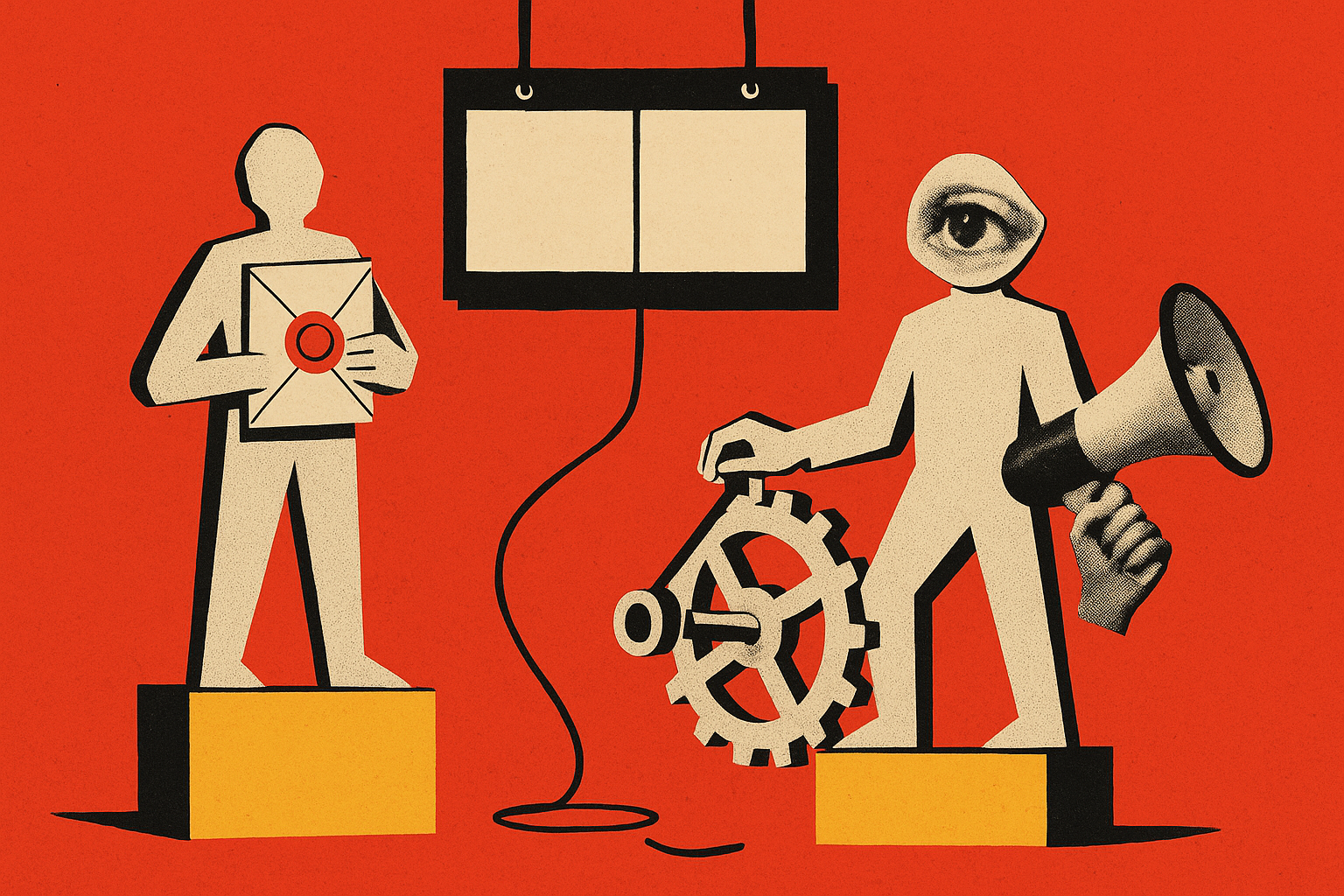
A brand consultant owes you a decision, a marketing consultant owes you a system
The two titles overlap enough that reading profiles won't sort them. What sorts them is the accountability object, and one sentence you write before you talk to anyone.
The branding agency decision gets made before you meet a single agency
Five capable firms will hand you five different theories of who your company is, and you'll pick the one that sounded best on a Thursday. The decision that matters happens before the first pitch, and it's yours.
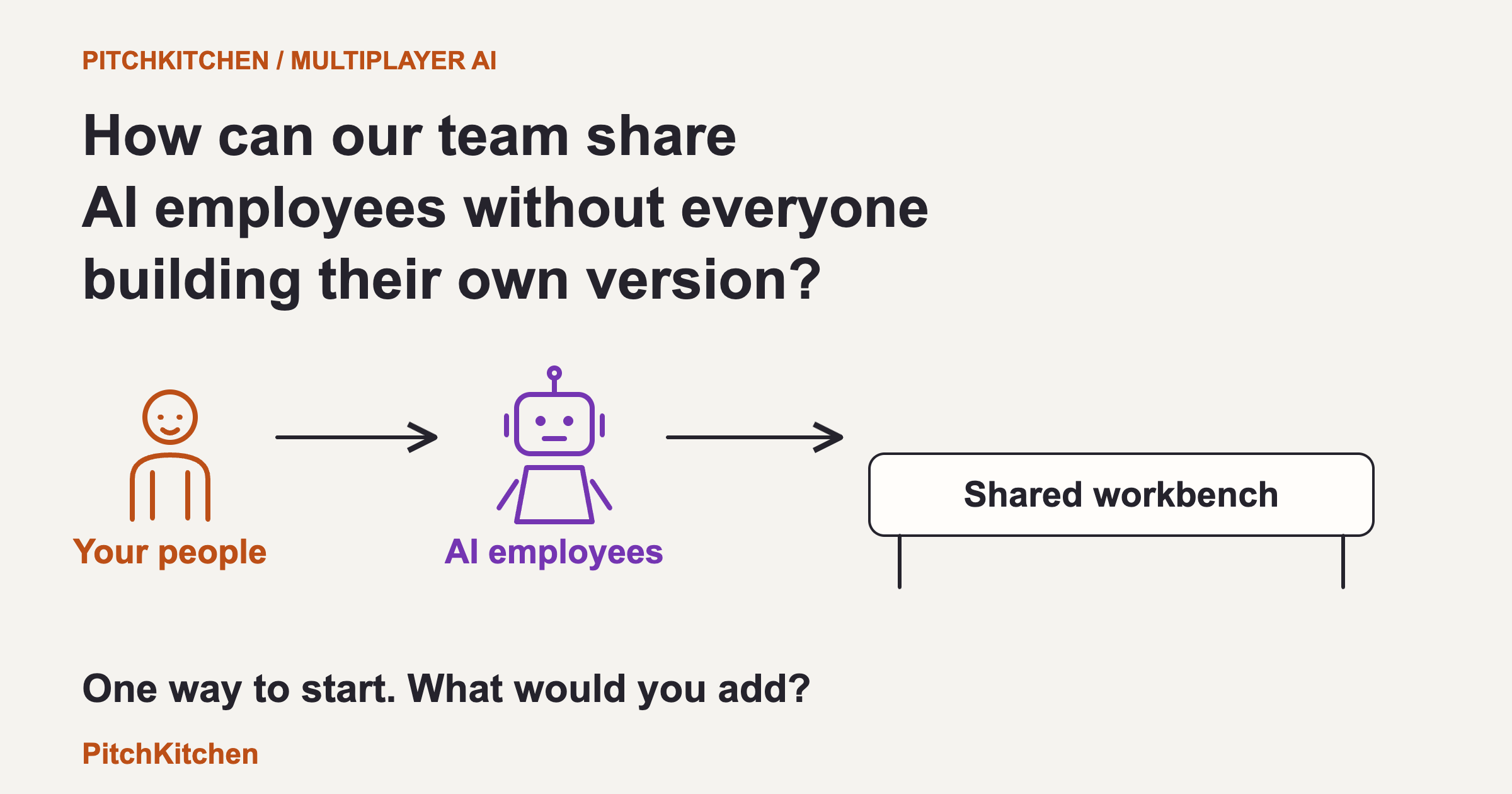
How can our team share AI employees without everyone building their own version?
Research. Prospecting. Proposals. Invoicing. A practical guide to sharing specialized AI employees, with human managers and clear handoffs.
We're raising prices. Do our customers re-buy or re-shop?
A CEO read me the price increase letter his lawyer had already cleared. Three paragraphs: thanks for the partnership, rising infrastructure costs, here's the new number. I asked what a customer gets for the extra nine percent and the line went quiet. Meet the Cost Confession, why the friction that used to protect a price increase is gone, and three tests to run before the letter goes out.
What actually happens in a two-week brand sprint, and what does it leave unfixed?
A two-week brand sprint is ten working days and it buys articulation: your leadership team's existing beliefs, said well. Here's the day-by-day agenda, the dependency hiding in each stage, and the four things ten days structurally can't reach.

How long does a B2B rebrand take, and what does each phase cost?
A full B2B rebrand runs four to eight months and $65,000 to $260,000 across six phases. Here's the timeline and the cost of each one, plus the phase that decides whether the other five stay on schedule.
Want this thinking built into your story?
The 90-Day Magnetic Messaging Sprint rebuilds it for you. Fixed price.
Strategy plus execution. Your story, homepage, sales deck, and an AI Brand Twin trained on your narrative ... rebuilt in 90 days. You own everything at the end.