Every article, newest first. Page 3 of 8.
Can we set up an MCP server so Claude writes in our brand voice?
Yes, and connecting it takes four minutes. What decides whether the output sounds like your company is what the server hands back when Claude asks, and tone adjectives won't do it.

How do we audit our website for what AI assistants say about us?
Most AI visibility audits are crawl checklists. Here's the six-step comprehension audit you can run in an afternoon, the four patterns it turns up, and what we found when we ran it on our own site.
How do we make our brand guidelines machine-readable so our AI tools can use them?
Machine-readable brand guidelines aren't a file-format problem. They're a rewriting problem: descriptions become decisions, rules get a condition they can fail, and the document gets split into units a tool can fetch one at a time.
The Reference Gap: why your happiest customer is the wrong one to put on the call
A CEO lost a $410K deal three weeks after handing the buyer his two best references. He assumed price. I asked what his references actually said on those calls, and he had no idea. Nobody in his company had ever asked. We called them, and the answer was forty seconds of warm, accurate, deal-killing praise.
The First-Sale Ceiling: why your biggest accounts stop growing at the problem you sold them on
A CEO showed me a slide last week: 340 customers, six products, 1.4 modules per account. He'd hired a customer marketing director, built in-app upsell prompts, run a webinar series. Nothing moved. Then I asked what his customers say he does, and he answered in four words without pausing.
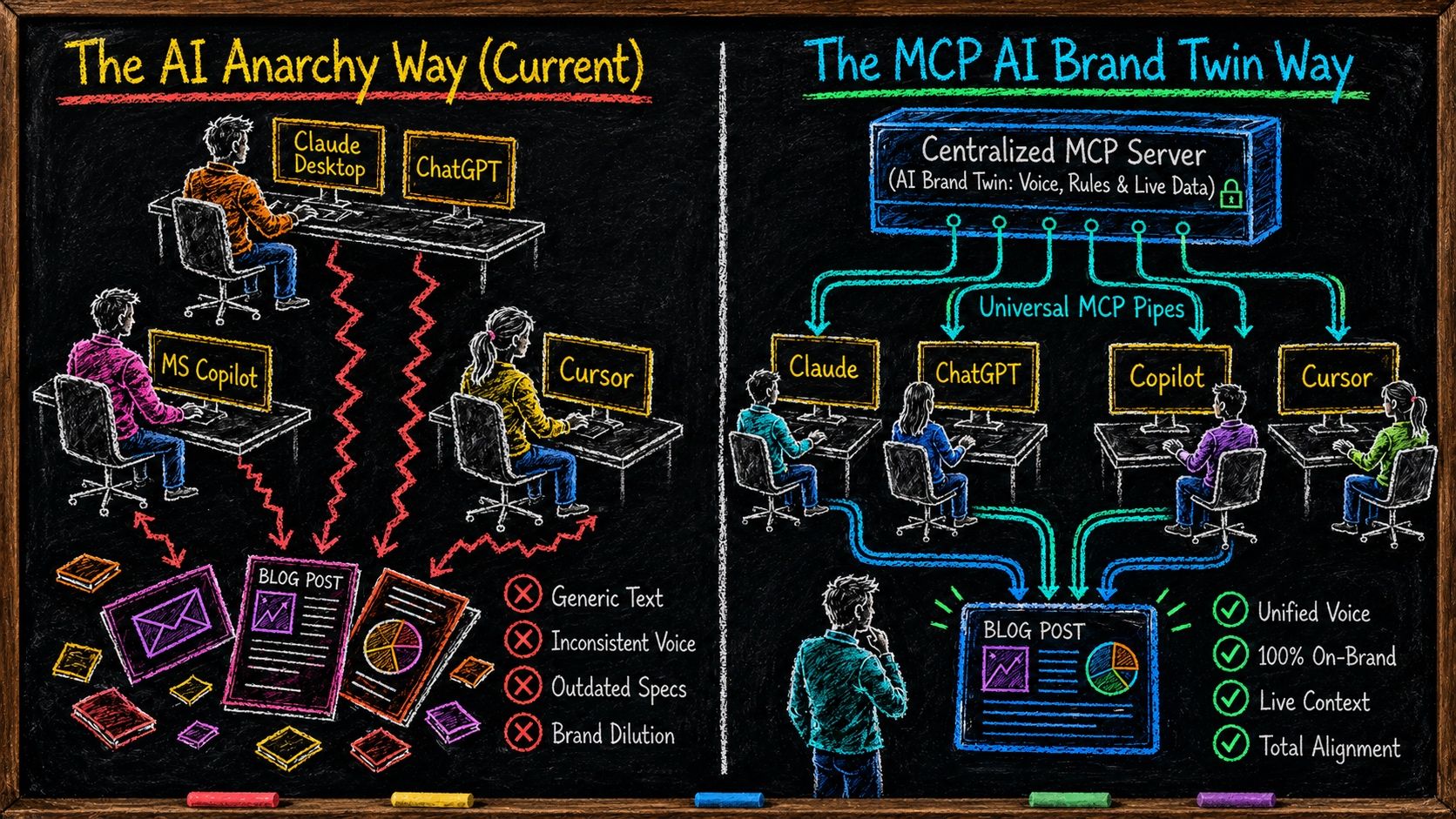
How do we get every AI tool our team uses to follow our messaging framework?
Your framework loses to the text box. Every person prompting AI re-summarizes your company from memory, and the model fills the gaps with the industry average. Here's how a messaging framework becomes an MCP server every tool queries live, and what has to be true before it helps.

Should we build an MCP server for our brand and messaging guidelines?
Most companies shouldn't build one yet. An MCP server distributes whatever you feed it, so if the positioning is still unsettled, it scales the confusion. Here's the 20-minute self-check that tells you which side of that line you're on.

What does a messaging engagement actually deliver, and how do you know it worked?
A messaging engagement delivers a documented narrative identity your team and your AI can both execute, plus the leading and lagging metrics to prove it moved buyers. Here's exactly what you get and how to measure it.
Should we sell features that are still on the roadmap?
A CRO sent me a call recording last week with one line above it: why is a deal we won in March already wobbling? Nineteen minutes in, his best rep hit a gap and said the sentence that closed it. That's on the roadmap for Q4. It wasn't on the roadmap. It was on a list.
Who writes the criteria B2B buyers evaluate you on?
A medical device software CEO forwarded me a forty-row vendor evaluation matrix and asked how he was losing on it. Eleven of the rows were near-verbatim from a competitor's 2024 buyer's guide. He'd been arguing with a document his competitor wrote, in a language his competitor chose, for two years.
Why does our board keep funding more leads instead of a better message?
A cybersecurity CEO had eleven marketing metrics on his board slide and every one of them was a count. He could name the real problem in ten seconds with the deck closed. There was nowhere on the slide to put it, so the board funded more of the lever he already knew was stuck.
The Hiring Tell: your job posts are positioning documents, and buyers are reading them
A fintech CEO lost a senior candidate last week because the job post and the homepage described two different companies. He had nine open roles live on his own domain, syndicated to four job boards, written by seven different hiring managers and reviewed by a lawyer. Nobody who owns the message had read a word of any of them.
The Manual Majority: why AI learns your company from your docs, not your homepage
Last week a healthtech CEO asked Claude a question buyers in his category ask every day. Two of the three paragraphs that came back were lifted almost word for word from his own help center. The recommendation at the bottom named his competitor. His documentation did the teaching and somebody else got the introduction. He had never read a single page of it.

Why does AI keep recommending firms from lists we're not on?
AI engines answer "who should we hire" with third-party lists, not vendor websites. Our tracking data shows which lists get quoted, which get ignored, and why list-makers leave growth-stage firms off.
Which pages actually get you cited by AI engines?
We tracked every page AI engines pulled from our site for five weeks. Nine of the ten most-retrieved pages were listicles or comparisons. Not one essay made the list, and we've published more than 250 of them.

How do AI engines decide which consultants to recommend?
AI engines sort consultants, they don't evaluate them. A services firm leaves almost no structured evidence behind, so the shortlist gets built from third-party lists and from whether your own language names a category, a buyer, and a fit. Our own tracking shows the same firm at two-thirds visibility in one category and zero in another.
Name Debt: why your clever product names cost you a sentence on every sales call
This week a cybersecurity CEO walked me through four products called Sentinel, Aegis, Fabric, and Pulse. It took eleven minutes. Slide four of his sales deck is a glossary that exists to translate his own company into English. That glossary is the interest payment on a naming decision nobody remembers making, and his reps pay it in every first call.
Outbound Inflation: why your AI SDR gets fewer replies every quarter
This week a healthtech CEO showed me a dashboard he was proud of: 41,000 outbound emails last quarter, up from 6,000 the year before. Reply rate went from 2.1% to 0.4%. Meetings stayed flat. He wanted to know which AI SDR vendor to switch to. When the cost of sending a pitch drops to zero, every pitch loses purchasing power, and buying a second agent is printing more money into your own inflation.

Going static made our site readable to AI engines. Getting recommended took different work.
We rebuilt pitchkitchen.com off Wix onto static HTML. It fixed retrieval and did nothing for recommendation. On our own category we still measure 0% across 39 tracked AI chats, with 11 live pages on it.

Why AI Engines Ignore Your Website (And the 19 Signals They Read Instead)
AI engines read a layer of your website your buyers never see: quotability, entity clarity, corroboration. Most B2B homepages send none of those signals.
Answer Engine Optimization for B2B CEOs: What We Track, What We Publish, What Works
The operating log of PitchKitchen's daily AEO practice: the four numbers we track, the publishing cadence, what's moving the visibility needle, and what we killed.

How We Got Our Consultancy Recommended by AI Engines (The Full Playbook)
Four months of daily publishing, 50 tracked buyer prompts, and a narrative identity models can repeat. The full operator playbook, receipts included.
Pipeline Archaeology: why your next quarter is buried in your closed-lost column
This week I sat in a pipeline review where a CRO scrolled past four hundred closed-lost rows to get to the net-new math. Every name in that column had taken a demo, met the team, asked about pricing. The entire plan for them was three automated nudges written by nobody. That column isn't a graveyard. Most of those buyers never actually decided anything, and the way back to them starts with changing the story, not the send date.

How to vet an agency's AI claims before you believe the demo
Every agency has an AI slide now, and every AI demo is good. The demo is good because a smart human spent an hour loading your company into a prompt window before the call. Five questions measure the distance between that hour and what you'll actually get in month four.

When it's actually time to hire a website redesign agency
"Our site looks dated" has funded more B2B redesigns than any buyer research ever has. Age isn't a trigger. Here are the three business changes that genuinely justify hiring a website redesign agency, the seven checks that tell you whether you have a design problem or a message problem, and the one very common reason founders buy a redesign that fixes nothing.

What a website redesign actually costs at $5M-$75M
A B2B website redesign runs $25,000 to $120,000 in the $5M-$75M range, and the number that moves it most isn't design quality. It's how many pages you asked them to rebuild. Most sitemaps in this band are two thirds archive.
What a messaging engagement costs at $5M, $20M, and $50M
A full messaging rebuild runs $25,000 to $45,000 at every revenue band. Revenue isn't what moves the number inside that range. The count of people who have to agree is.
The Thinking Line: what B2B messaging, branding, and GTM consulting actually costs in 2026
Founders line five quotes up in a spreadsheet sorted by price, and the column makes work that isn't comparable look comparable. The spread between $6,500 and $240,000 isn't quality. It's the thinking line: whether you're buying output, or buying a decision.

Calendar Shopping: what a brand sprint can compress, and what it can't
Founders compare a five-day brand sprint against a six-month brand strategy engagement on the only number both proposals share: duration. That's the wrong axis. A sprint compresses articulation. It can't compress a decision nobody has made yet.
Line Item Zero: what branding costs in 2026, and the one row no quote includes
Startup and growth-stage branding runs from $3,000 to well past $250,000, and every line on the quote prices execution. The row that decides whether any of it moves pipeline never gets quoted at all.

Scope Cliff: how to choose a B2B branding agency that actually moves pipeline
Most B2B branding engagements end at the brand book. Pipeline moves somewhere past that line. Here's the scope cliff, why a portfolio can't predict it, and five tests to run on any branding agency before you sign.
The Offsite Trinity: why mission, vision, and values can't sell your product
This week a CEO showed me the output of a two-day leadership offsite: a mission, a vision, five values, all wordsmithed to a shine. Ninety days later his pipeline hadn't moved. I asked him to read me the mission statement and name one competitor who couldn't say it word for word. Long pause. The Offsite Trinity answers questions your team cares about. A buyer is asking different ones, and your homepage only gets to answer one set.

Repaint Reflex: why we buy a rebrand when what's actually broken is the position
A rebrand changes what your company looks like. A repositioning changes what it means. Most B2B companies buy the first when they need the second, because surface is easier to scope than an argument.

Story Anesthesia: why a great story hides a broken position instead of fixing it
Storytelling and positioning are different jobs, and only one of them can be broken first. Here are the three tests that tell you which one you're actually paying to fix.

Census Segments: your target market list counts companies, it doesn't find buyers
Most B2B companies segment their market by industry, headcount, and tech stack. That's a census, not a segmentation. Here's the three-question test that finds the segments that actually predict buying.

Orphan Line: why your tagline is the only sentence you own that always travels alone
Every other line you write has backup. A headline has a subhead. A slide has the next slide. Your tagline goes out with nothing after it, onto deck covers, email signatures, and into the one sentence an AI engine says about you. Here's how to write one that survives alone.

Rearview Clarity: why your homepage hero only makes sense to people who already know what you do
Open twenty B2B homepages in a row and the heroes blur together. Different companies, different categories, roughly the same nine words. The problem usually isn't bad writing. It's that the hero reads perfectly to everyone who already knows the answer, which is everyone who approved it. Here's the build: the five slots a hero needs to survive five seconds with a stranger.

Borrowed Ground: why most sales battlecards make your reps argue on the competitor's terms
Open the enablement folder at almost any B2B company and the battlecard looks the same: competitor name on top, their claims on the left, your rebuttals on the right. That card was built from their website instead of your narrative, and it hands your rep the competitor's frame before the call starts. Here's how to build one from your core narrative instead.
Proof Order: how to structure a product demo around the buyer's problem instead of a feature tour
Open almost any B2B demo recording and you can predict the first four minutes: login, dashboard, main workspace, newest feature. That sequence isn't a sales decision. It's the product's navigation menu read out loud to a buyer. Here's the build, not the diagnosis: how to decide the claim first and let it dictate what you show, in what order, and what gets cut.
Win Amnesia: how to mine win/loss calls for the language that actually closes deals
Every B2B company runs a loss autopsy. Almost none run a win debrief. That asymmetry is Win Amnesia, and it's why the language that actually closes your deals never makes it out of the recording.

Frame Surrender: how to write objection-handling talk tracks that stay on your narrative
Every rep on your team has a moment where they stop selling your company and start defending it. That's Frame Surrender, and it happens in the thirty seconds after an objection lands. Here's how to write talk tracks that answer the objection without handing the buyer your narrative.
Podium Marketing: why AI trusts a Reddit thread more than your homepage
A founder watched ChatGPT build a shortlist in his category, then asked what real users say. The machine quoted a two-year-old Reddit thread he'd never seen, where his company appeared once, as a question nobody answered. That's Podium Marketing: speaking only from stages you own while the rooms that decide your reputation go unattended.
Naming Rights: why the company that names the problem owns the market
A buyer asked my client how his product handled a problem, using the two-word phrase a weaker competitor coined last year. That's the Rented Vocabulary at work: buyers interviewing you in someone else's words. Why the company that names the problem ends up owning the conversation, and three tests to find out whose words you're speaking.

Portfolio Hypnosis: why enterprise software companies keep hiring the wrong messaging agency
You choose a messaging agency for enterprise software by testing it against the shape of your deal, not the beauty of its portfolio. Here's the failure mode, the seven filters that separate fit from polish, and three tests that fit inside one finalist call.

Echo Work: what to expect in the first 30 days of a messaging engagement, and the red flag most founders miss
A good first month produces almost nothing you can put in a board deck. That's the point. When a polished artifact lands in week two, it means the firm built from your website instead of from your people, and you're already three months from finding out.
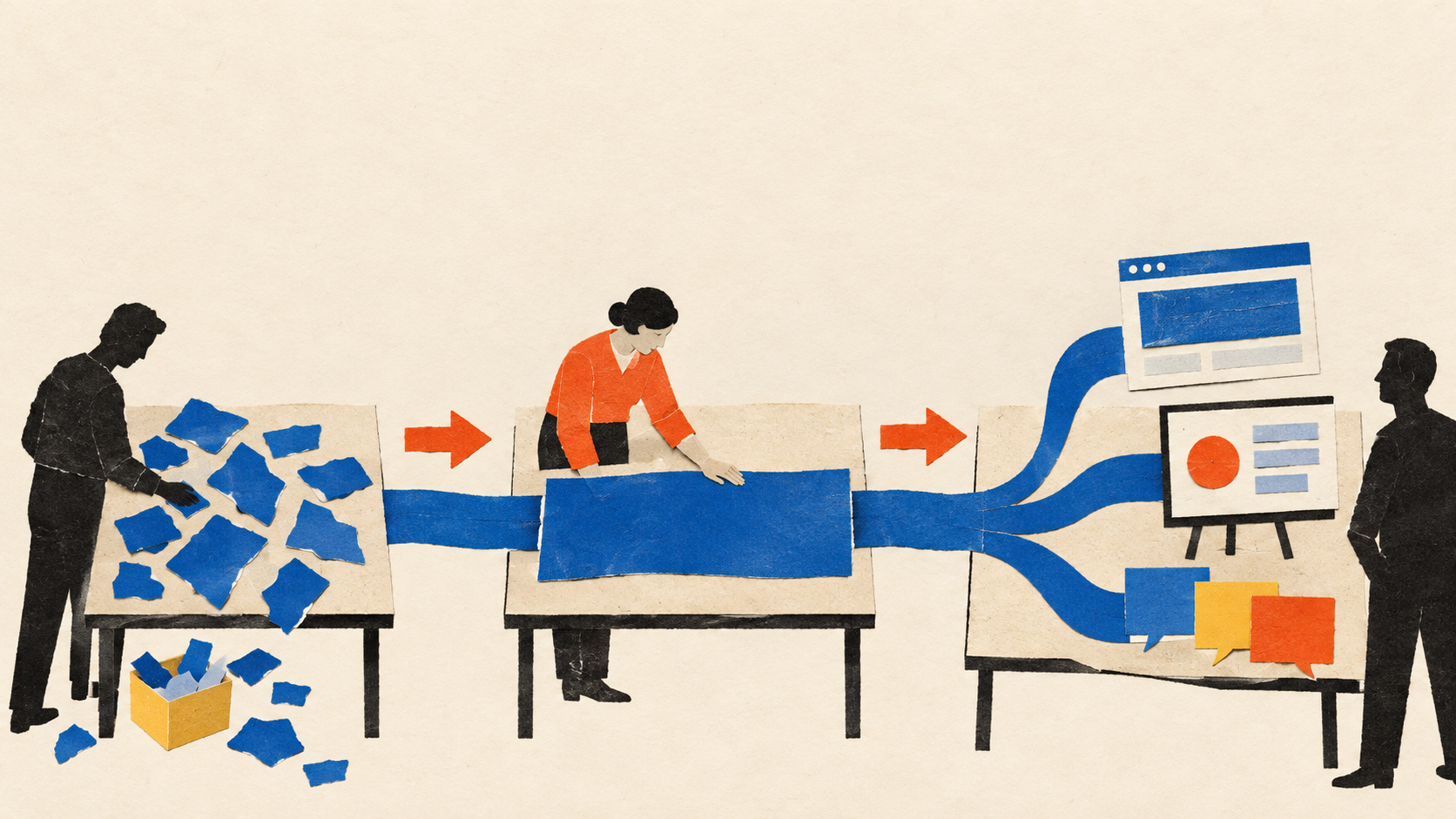
How we build a B2B messaging framework and put it to work in 90 days
Your homepage rewrite is waiting on a sentence your leadership team still can't agree on. You could put another meeting on the calendar. You could ask AI for twenty versions. Neither gives you a way to decide which version is true.

Additive Repositioning: why most B2B repositioning projects change everything but the position
B2B brand repositioning changes which problem you're the obvious answer to, and for whom. Most projects never get there, because nobody gives anything up. Here's the definition, the difference from a rebrand, and four tests to run before you spend a dollar.

The Silent Read: half of what AI knows about you never shows up on your dashboard
AI search reads about twice as much as it credits. Here's the difference between being used and being cited, why your visibility dashboard can't see the half that matters most, and what actually moves the layer you can't measure.
Or find your problem